Passive Mixer
We have multiple audio sources in every room. They include TVs, desktops, laptops, Alexa Dots, and even electric guitars. They all sound much better when amplified. I used to be an audiophile many years ago, but I now find that I can get acceptable performance from budget priced computer speaker systems in each room. I have several systems from Klipch and Logitech. They are rated at about 50W RMS and include a subwoofer. Each room gets very good sound when the stereo speakers are placed strategically and the woofer is hidden somewhere. The sound systems support Bluetooth and allow music to be played from a mobile device. Older systems don't have Bluetooth, but I can connect to a Dot that is connected to the speakers.
The problem is that the sound systems typically have only one input jack and can accept only one audio source at a time. This note describes a simple way to merge multiple audio inputs. It is a passive circuit, with no transistors or ICs, and does not need to be powered.
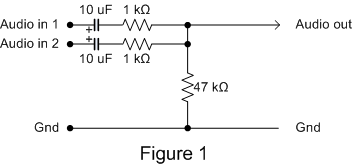
The circuit is conceptually simple. It uses a standard passive resistor summing network as shown in Fig 1. The two 1kΩ resistors isolate the audio inputs so they don't drive directly into each other (which can distort audio or damage output stages). The 47kΩ pull-down resistor ensures a stable ground reference when sources are disconnected and closely matches the standard input impedance of home amplifiers (10 to 100kΩ). The 1kΩ resistors could be increased to 4.7kΩ, to avoid loading down the amplifiers, but there would be a noticeable loss of volume.
The optional 10µF capacitor blocks DC offsets, protects the audio devices amplifiers, and eliminates "popping" noises when connecting or disconnecting sources. If used, connect the positive (+) lead facing the audio device inputs and the negative (-) lead facing the 1kΩ summing resistors / mixer output. Most audio output stages (especially single-supply amplifiers) often sit at a slight positive DC bias (e.g., +1.5V to +2.5V) relative to ground, while the passive mixer circuit itself sits near true ground. A 1µF capacitor could also be used, but there may be some loss of bass frequencies. I chose not to use any capacitors, it worked fine with PCs and Alexa Dots.
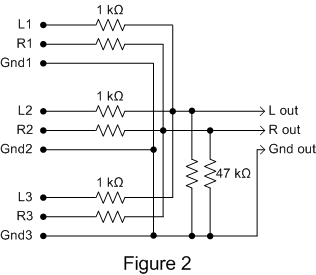
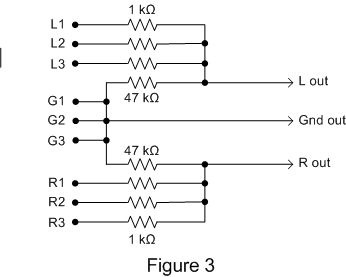
Figure 2 expands the circuit to allow for three stereo inputs, and Figure 4 rearranges it to show a suggested layout. Instead of three, you could have as many inputs as your situation requires.
You could also add volume control potentiometers ahead of the summing resistors. This would allow the volume of each audio source to be adjusted relative to the other sources. Use a 10kΩ (or 50kΩ) dual-gang audio-taper (logarithmic) potentiometer. I did not need this since I had volume controls on all my audio sources.
Unfortunately, this gadget will not work directly for mixing microphone signals. Outputs from typical audio sources are suitable for headphones. They measure at about 1V RMS and have a low output impedance of about 4Ω to 100Ω. Microphone outputs are about 1mV to 10mV RMS - they are much weaker. Using a microphone preamp would raise the signal up to Line Level (~1v RMS) and this signal can be fed into the mixer. Condenser microphones require +48V Phantom Power (or plugin power) which can be provided by a preamp.
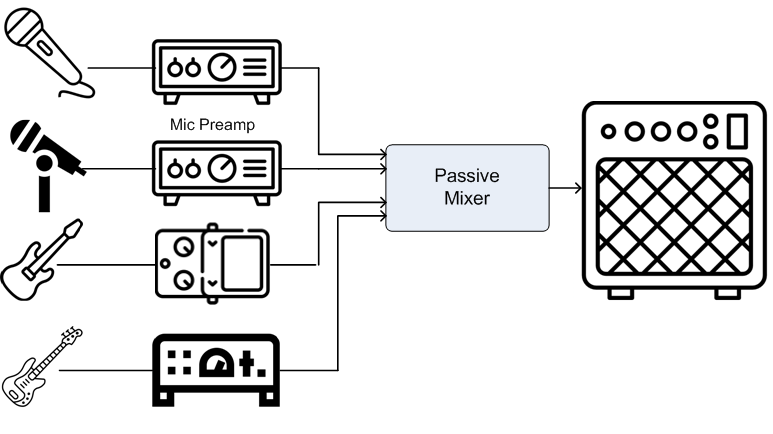
Electric guitars also require a preamp, Buffer Pedal or a Direct Injection (DI) Box. Though guitar pickups generate a higher voltage than microphones, they have high output impedance (~10kΩ) rising significantly higher (1MΩ) at upper audio frequencies. The mixer’s input impedance is about 50kΩ. Connecting a guitar to this mixer heavily loads down the passive pickups. This creates a low-pass filter effect that strips away high frequencies, making the guitar sound muffled, dull, and weak. After adding a suitable preamp or pedal, the signals can be mixed using a passive mixer. This allows a number of mikes and guitars to be connected to a single amp.
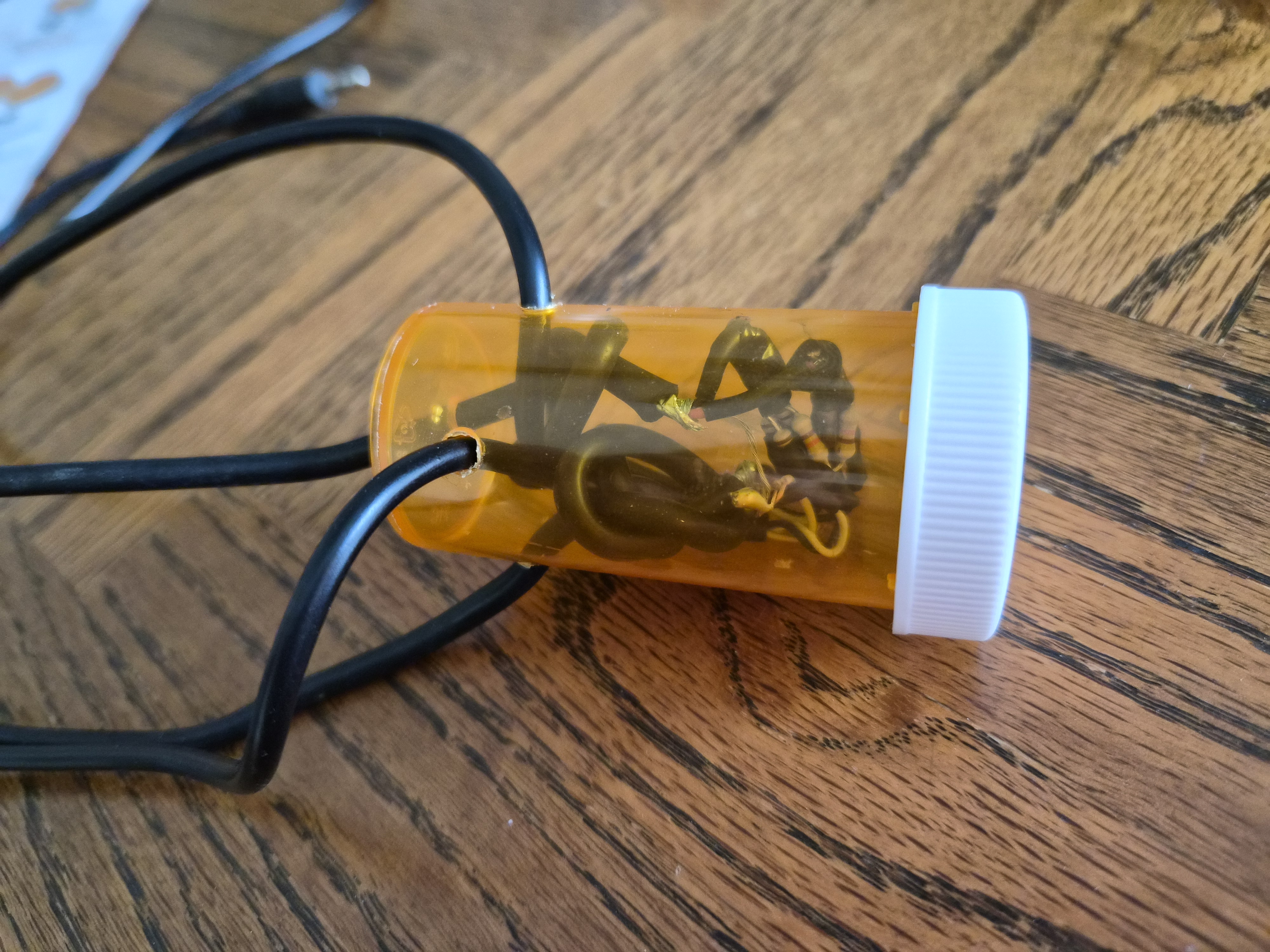
I packaged the resistors inside a prescription tablet container with 4 holes drilled in. I used two 6 ft audio cables, each cut in half, to serve as the three inputs and one output. Depending on your requirements, you could cut the cables so that some are longer. Thread the cables in first, then add a knot before connecting the resistors. The knot acts as a strain relief and protects the connections if someone pulls on the cable. Make sure to use shrink wrap or electrical take to insulate all connections. There is no circuit board required.
Passive mixers like this are available for about $20, but my mixer does not need any additional cables and has a transparent case. So there…
All in fun
Jul 2026